Saturday, 4 July 2026

RAMFAN EB7325-WT Wing Tank Vent Cart: IECEx-Certified MRO Ventilation for Aircraft Fuel Tank Safety


RAMFAN EB7325-WT Wing Tank Vent Cart: IECEx-Certified MRO Ventilation for Aircraft Fuel Tank Safety

Aircraft fuel tanks present one of the most unforgiving confined-space hazards in industrial maintenance. Residual fuel vapors, aerosol contaminants, and toxic fumes accumulate inside wing tanks before maintenance crews even touch a tool, and a single ignition source inside that space changes everything. Ground crews need ventilation that deploys immediately, handles dual-wing configurations in a single pass, and carries genuine hazardous-location certification, not a disclaimer buried in fine print. The RAMFAN EB7325-WT Wing Tank Vent Cart is engineered specifically for that scenario, arriving factory-mounted, palletized, and ready to connect.

What is the RAMFAN EB7325-WT Wing Tank Vent Cart and what does it do?

The RAMFAN EB7325-WT is a complete, mobile ventilation system purpose-built for Maintenance, Repair, and Overhaul (MRO) operations on aircraft wing fuel tanks. It combines an explosion-proof fan, conductive ducting, a wye splitter, inspection lighting, and a centralized power distribution box on a single cart frame, allowing ground crews to establish compliant confined-space ventilation with one AC connection and minimal setup time.

The cart weighs 690 lbs (313 kg) and measures 48" x 32" x 74" (122 x 81 x 187 cm). It accepts a single 115/230 VAC, 50/60 Hz supply and distributes power to all onboard equipment through a dedicated AC power distribution box rated at 16 amps across both voltage configurations. This single-source power architecture eliminates the extension cord sprawl that creates tripping hazards on crowded hangar floors.

What IECEx and ATEX certifications does the EB7325-WT carry, and why do they matter for fuel tank work?

The EB7325-WT is engineered with IECEx-certified components, and the core ventilator, the RAMFAN EFi75xx, carries both ATEX and IECEx whole-unit certification for use in hazardous locations and explosive atmospheres. These are not self-declared ratings; IECEx and ATEX are internationally recognized third-party certification schemes covering equipment used where flammable gases, vapors, or dust may be present, exactly the conditions inside an aircraft fuel tank during MRO.

The EFi75xx fan motor is a Totally Enclosed Air-Over (TEAO) type rated at 0.75 hp. TEAO construction prevents internal combustion pathways by sealing the motor windings from the surrounding atmosphere, a critical design requirement when the surrounding atmosphere may contain Jet-A or aviation gasoline vapors. The IECEx certification scheme published by the International Electrotechnical Commission governs the testing and marking of this equipment class, and the EFi75xx's whole-unit certification means the assembled fan, not just isolated components, has passed that evaluation.

How does the EF7400 Duct Wye Splitter enable simultaneous dual-wing ventilation?

The EF7400 Wye Duct Splitter transitions from a single 12-inch main duct diameter down to dual 8-inch branch ducts, allowing the EFi75xx ventilator to push airflow into both wing tanks simultaneously from one fan. When only one wing requires ventilation, the same wye configuration supports single-wing operation without removing or reconfiguring the splitter body.

The wye splitter measures 12" x 8" x 8" and is described in the product specifications as tough and durable, sized for maximum airflow preservation through the transition. Each branch connects to a wing tank through the EF7300 Vent to Wing Tank Adapters (two included), which interface the duct end to the specific tank access geometry of the aircraft under maintenance. The ducting inventory on the cart includes four lengths of 8-inch conductive black duct (part FDT-0825CBB, each 25 feet / 7.6 m long), one length of 12-inch conductive black duct (FDT-1215CBB, 15 feet / 4.6 m), and one 100-foot (30 m) roll of 12-inch anti-static disposable duct (FDT-12DISPX), providing enough reach for wide-body aircraft wing geometries.

Why is conductive and anti-static ducting required for aircraft fuel tank ventilation?

Standard plastic ducting accumulates static charge as air and fuel-vapor particles move through it at velocity. Inside a fuel tank, that static discharge is an ignition source. Conductive and anti-static duct materials provide a continuous electrical path that bleeds charge to ground rather than allowing buildup to a spark-level potential.

The EB7325-WT inventory specifies conductive black duct (parts FDT-0825CBB and FDT-1215CBB) for the permanent duct runs and an anti-static disposable duct (FDT-12DISPX) for the 12-inch main trunk. This distinction matters operationally: the disposable anti-static duct can be discarded after contact with heavily contaminated tank atmospheres, preventing cross-contamination between aircraft without sacrificing the static-control property. Stainless steel duct couplers (DC12, 12-inch) and plastic couplers (DC8P, 8-inch) complete the connections without introducing metal-on-metal friction points inside the duct path.

What safety features on the EB7325-WT prevent hazards during hangar deployment?

The cart incorporates an automatic braking system that engages when the unit is unattended, preventing uncontrolled rolling on sloped or uneven hangar floors. Wheels are rugged, rubberized 8-inch units designed for hangar and tarmac surfaces. Integrated tie-down straps secure equipment during transport or when the cart is deployed in environments subject to aircraft blast or weather.

The power distribution box (part AT-SSPLEX4C110A2PEA-2PEA10) consolidates all equipment connections into four EX-rated socket outlets, keeping cabling organized and short. This reduces the number of independent power runs on the hangar floor and the associated tripping and arc risk. The lighting complement includes a 3-LED floodlight (AT-SS3LEDA110A2PEA10) for under-wing inspection and two handheld inspection lights (AT-SSP110A2PEZ10) for in-wing work, all powered from the same distribution box. Storage boxes on the cart frame house the conductive ducting, couplers, and adapters so components are not left loose on the floor around the aircraft.

Which aircraft maintenance environments is the EB7325-WT designed to operate in?

The EB7325-WT is designed for General Aviation (GA) facilities, commercial airline airport hangars, and military bases. The cart's factory-mounted and palletized configuration means it ships ready for deployment and can be repositioned within a facility or between facilities without disassembly. Its rugged construction supports outdoor tarmac use as well as enclosed hangar environments.

Beyond fuel tank ventilation, the system accommodates broader MRO tasks: extracting toxic dust, fumes, aerosol contaminants, and vapors from confined aircraft spaces, and functioning as a mobile cabin air filtration or ventilation system. This operational range makes the cart a multi-task asset rather than a single-use item, which matters when a maintenance facility needs to justify capital equipment against multiple work orders. For a complete overview of deployment-ready MRO ventilation options, the RAMFAN Aircraft Ventilation Solutions product line covers the broader family of systems available for aviation applications.

What are the complete contents of the EB7325-WT parts list?

The EB7325-WT ships as a complete system. The Mobile Aircraft Fuel Tank Venting Cart frame is part MK-999940. The ventilator is the EFi75xx 12-inch unit at 115 VAC (part EB7201XX), mounted with the EB6100K mounting kit. Ducting consists of four lengths of 8-inch conductive black duct (FDT-0825CBB), one 12-inch conductive black duct (FDT-1215CBB), and one 12-inch anti-static disposable duct roll (FDT-12DISPX). The duct wye splitter is the EF7400, with connections made via a 12-inch stainless coupler (DC12) and 8-inch plastic couplers (DC8P). Two EF7300 wing tank adapters interface the ducts to the aircraft.

The lighting package and power distribution box complete the system. A 48-inch x 0.5-inch zip-tie (EZT48) is included for securing duct runs. Every component ships factory-installed and tested on the cart. This matters for MRO operations where procurement, assembly, and certification of individual components from separate vendors would each add lead time and introduce integration risk.

Where is the RAMFAN EB7325-WT applied in practice?

The EB7325-WT sees primary application in aircraft wing fuel tank purging before entry for inspection, repair, or fuel system component replacement. The simultaneous dual-wing capability of the EF7400 wye splitter reduces the ventilation phase of the MRO sequence, letting maintenance crews move to the next task phase without repositioning the cart between tanks.

Secondary applications include cabin ventilation during interior refurbishment, where solvent fumes from adhesives and sealants require continuous air movement, and extracting composite dust generated during fuselage or wing surface repairs. Military base MRO shops, which often operate under tighter deployment timelines than commercial facilities, benefit from the palletized-and-ready configuration. For detailed technical context on the EB7325-WT's design rationale and safety value, see Enhancing Aircraft Safety with the RAMFAN Wing Tank Vent Cart and the in-depth operational breakdown at RAMFAN Wing Tank Vent Cart (EB7325-WT): The Fastest, Safest Way to Clear Fuel Vapors. Procurement teams evaluating the full system can review specifications directly on the Ramfan EB7325-WT Wing Tank Vent Cart product page. Additional safety and deployment guidance is available through the RAMFAN Wing Tank Vent Cart: The Aircraft MRO Ventilation System resource article.

When is the EB7325-WT the right choice, and when is it not?

The EB7325-WT is the right specification when a facility performs recurring wing fuel tank MRO work across multiple aircraft types and needs a self-contained, IECEx/ATEX-certified system that deploys without component sourcing or assembly. The 115/230 VAC dual-voltage capability makes it functional across North American and international hangar power standards without an additional transformer. The automatic braking, organized power distribution, and integrated lighting address the ergonomic and safety audit requirements of both commercial and military MRO environments.

The EB7325-WT is not the right tool for facilities that require only single-duct point extraction without the full cart infrastructure, or for operations where the 690 lb cart weight and 48" x 32" footprint cannot be accommodated in tight maintenance bays. In those scenarios, a standalone EFi75xx ventilator with individual ducting components would be the appropriate alternative from within the same RAMFAN product family. The full scope of portable aviation ventilation alternatives is covered under the RAMFAN Aircraft Ventilation Solutions category.

Technical Specifications


RAMFAN EB7325-WT Wing Tank Vent Cart - Aircraft MRO Ventilation System


Wing Tank Vent Cart

EB7325-WT

Wing Tank Vent Cart in use

Efficient and Adaptable Ventilation System for Aerospace Ground Crews

The RAMFAN Wing Tank Vent Cart (EB7325-WT) is designed for aerospace ground personnel performing Maintenance, Repair, and Overhaul (MRO) on various aircraft.

The cart provides efficient and immediate setup of aircraft pre-flight ventilation and fuel tank maintenance.

Key Features

Certified for Hazardous Environments IECEx-certified components for use in explosive atmospheres
Adaptable Components for Ultimate Flexibility Work with different tank configurations and maintenance tasks, including extracting toxic dust, fumes, aerosol and vapor contaminants, or as a mobile cabin air filtration or ventilation system
Minimizes Workspace Hazards Includes power distribution box for all equipment power connections and minimal cabling, added safety features including automatic braking, adjustable mounting straps, and extra storage boxes
Ideal for Multiple Environments Rugged design enables use in many environments, including General Aviation (GA), Commercial Airline Airport Hangars, and Military Bases. Factory mounted, palletized, and ready for deployment worldwide

Cart System Diagram

Cart System Diagram

Powerful floodlight and 2 handheld inspection lights

Storage boxes for included conductive ducting, couplers, and adapters

AC power distribution box with 4 EX socket outlets

Integrated tie down straps for extra security

Duct wye splitter for single or simultaneous ventilation of both wings

Automatic braking system prevents rolling when unattended

RAMFAN EFi75xx explosion-proof ventilator designed for use in adverse environments

Whole-unit certification of the EFi75xx for use in hazardous locations and explosive atmospheres

Tough and Durable 12" x 8" x 8" Wye Duct Splitter for maximum airflow. Single wing capable

Single AC power source minimizes equipment, cables, and tripping hazards

Automatic locking brake system with rugged and rubberized 8" wheels

AC Power Distribution Diagram

Engineered with IECEx-certified components for safe operation in hazardous environments and explosive atmospheres.

The RAMFAN Wing Tank Vent Cart (EB7325-WT) provides a highly efficient and adaptable solution for aerospace ground crews tackling Maintenance, Repair, and Overhaul (MRO) tasks. Designed for flexibility, the cart accommodates a range of tank configurations and tasks, from extracting toxic fumes and vapor contaminants.

110/230AC Input → Power Distribution Box → Outputs:

  • • 3-LED Floodlight for Under-wing Inspection
  • • In-wing Inspection Lights (2)
  • • EFi75xx with wye-duct adapter and anti-static ducting
  • • Duct to Wing Tank Adapters (2)

Parts List

Description Part #
Mobile Aircraft Fuel Tank Venting Cart MK-999940
EFi75xx 12" Ventilator – 115 VAC (ATEX / IECEx Certified) EB7201XX
Duct Wye Splitter, 12" to dual 8" diameter EF7400
Conductive Black Duct (8" / 20 cm diameter x 25' / 7.6 m length), qty 4 FDT-0825CBB
Conductive Black Duct (12" / 30 cm diameter x 15' / 4.6 m length) FDT-1215CBB
Anti-static Disposable Duct (12" / 30 cm diameter x 100' / 30 m length) FDT-12DISPX
Duct Coupler, Stainless (12" / 30 cm diameter) DC12
Duct Coupler, Plastic (8" / 20 cm diameter) DC8P
Vent to Wing Tank Adapter, qty 2 EF7300
EFi75xx Mounting Kit EB6100K
Zip-tie, 48" length x 0.5" width EZT48
3 LED Floodlight (110 VAC) for under-wing inspection AT-SS3LEDA110A2PEA10
Handheld Inspection Lights (110 VAC) for in-wing inspection, qty 2 AT-SSP110A2PEZ10
Power Distribution Box AT-SSPLEX4C110A2PEA-2PEA10

Technical Specifications

Net Weight 690lbs / 313kg
Dimensions 48"x32"x74" / 122x81x187cm
EFi75xx Fan Motor Output Power 0.75 hp
Motor Type TEAO
Electric 115 / 230 VAC, 50 / 60 Hz, 1 (both voltages available)
Power Distribution Box Amps (all outputs active) 115 / 16A    230 / 16A

Durability and safety are at the core of the Wing Tank Vent Cart's design.

Features such as a power distribution box for organized connections, automatic braking for stability, and adjustable mounting straps enhance operational efficiency while minimizing workplace hazards. Built to withstand challenging environments and ready to deploy. Fully factory-mounted and palletized, it is a dependable and reliable solution that meets the demands of modern aviation maintenance and repair.


Originally Published Here: RAMFAN EB7325-WT Wing Tank Vent Cart: IECEx-Certified MRO Ventilation for Aircraft Fuel Tank Safety

Friday, 3 July 2026

Tempest PAL-30 Industrial Ventilation Fan: High-Volume Warehouse Cooling with 30-Inch Propeller Performance


Tempest PAL-30 Industrial Ventilation Fan: High-Volume Warehouse Cooling with 30-Inch Propeller Performance

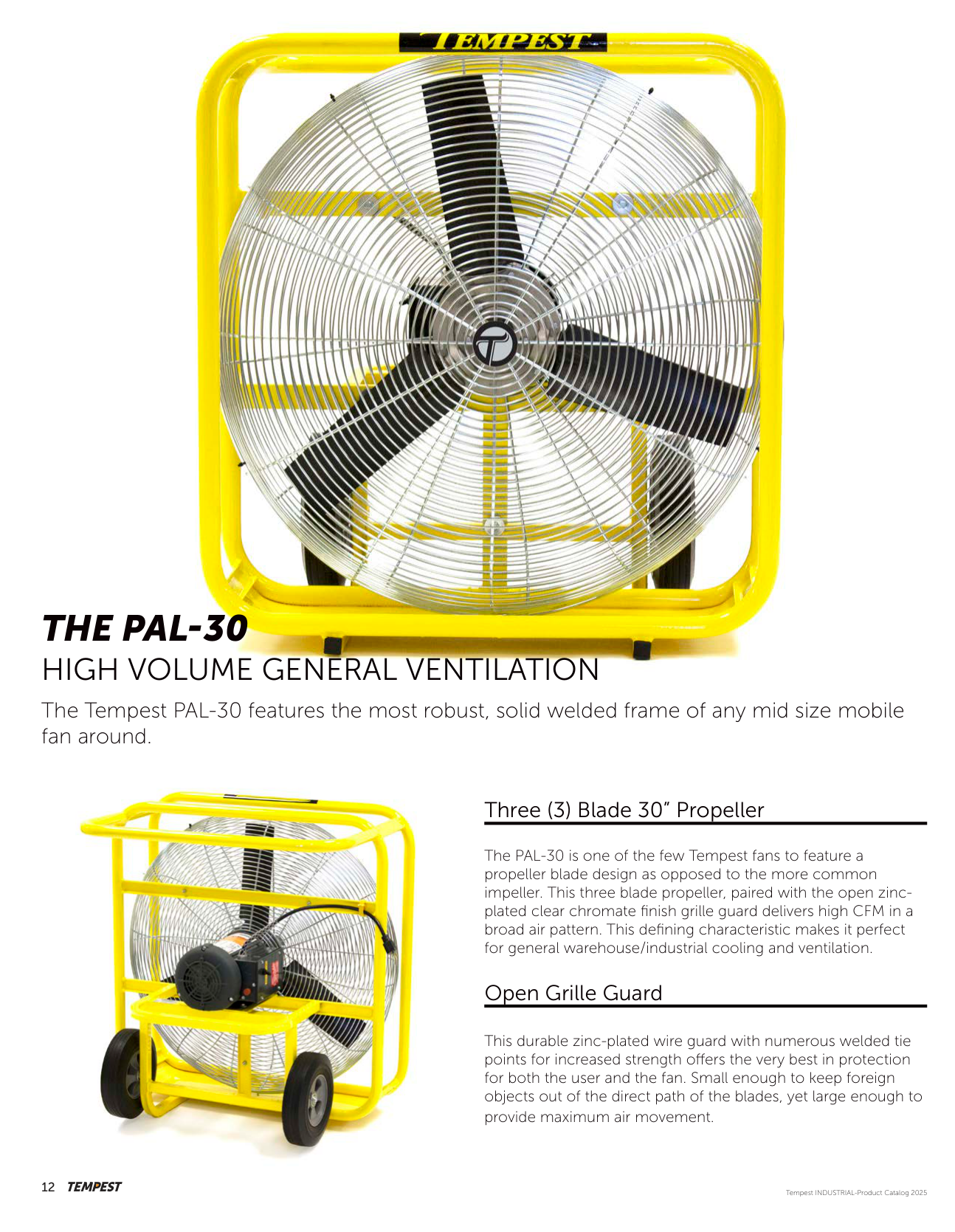
Warehouse managers and industrial facility operators know the problem well: a standard box fan moves air in a tight cone, leaves hot pockets in the corners, and barely makes a dent in a 50,000-square-foot floor. Multi-blade impeller fans traded broad coverage for concentrated throw distance. Neither tool solves large-area cooling without a fleet of units running on every circuit you own. The Tempest PAL-30 takes a different engineering path. Its three-blade 30-inch propeller generates up to 15,072 CFM in a wide, diffuse air pattern that covers broad floor space in a single pass, paired with a firefighting-proven shroud and a frame built to survive continuous industrial service. Here is exactly what the hardware delivers and when it is the right tool for the job.

What is the Tempest PAL-30 and how does it differ from impeller-style industrial fans?

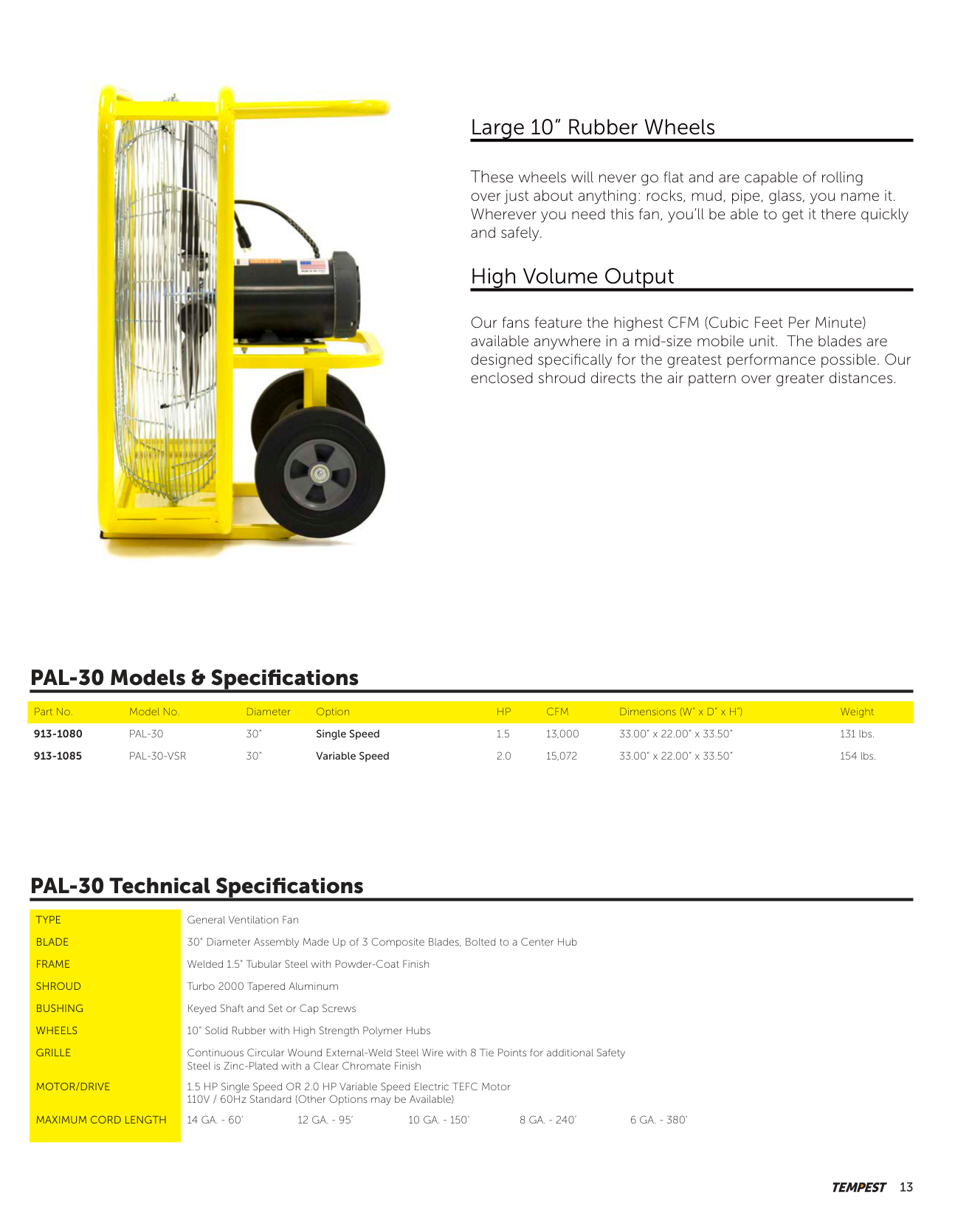
The Tempest PAL-30 is a 30-inch, three-blade propeller ventilation fan rated for general high-volume industrial airflow, producing 13,000 CFM at 1.5 HP on its single-speed model and 15,072 CFM at 2.0 HP on the variable-speed PAL-30-VSR. The propeller blade geometry delivers a broad, wide air pattern rather than the concentrated jet associated with multi-blade impeller designs.

Tempest's own impeller fans use eight blades arranged to generate a tight, high-velocity column suited for directed smoke or fume extraction. The PAL-30's three composite blades bolted to a center hub trade that concentrated column for lateral spread, making it the better choice when the goal is cooling workers and equipment across a wide floor area rather than purging a defined duct or corridor. Both designs share the Turbo 2000 Tapered Aluminum Shroud, which Tempest rates for a 30% increase in air velocity over an open-blade configuration of equivalent diameter.

How does the Turbo 2000 Tapered Aluminum Shroud increase airflow performance?

The Turbo 2000 Tapered Aluminum Shroud is a converging-profile aluminum housing that accelerates air leaving the blade disk by reducing turbulent boundary separation at the blade tips. Tempest rates the shroud design for a 30% velocity gain compared to operating the same propeller in an open or straight-wall frame, while keeping the overall fan footprint compact at 33 inches wide by 22 inches deep by 33.5 inches tall.

The tapered shroud geometry was originally developed and proven in Tempest's firefighting positive-pressure ventilation lineup, where reliable throw distance in an uncontrolled outdoor environment is a life-safety requirement. Carrying that shroud design into the PAL-30 means the industrial fan inherits the same velocity efficiency, which directly translates to greater effective ventilation distance from a single fan position. For a facility manager trying to cover maximum floor area from a limited number of electrical circuits, that 30% velocity gain is operationally significant.

What motor and electrical options does the PAL-30 offer, and how far can it run from a panel?

The PAL-30 ships in two motor configurations: a 1.5 HP single-speed TEFC (Totally Enclosed Fan-Cooled) electric motor at 110V/60Hz producing 13,000 CFM (part number 913-1080), and a 2.0 HP variable-speed TEFC motor at 110V/60Hz producing 15,072 CFM (part number 913-1085, designated PAL-30-VSR). Both motors operate on standard 110V single-phase power, which means no dedicated three-phase circuit is required for deployment.

Extension cord capacity is a practical constraint in large industrial facilities, and Tempest publishes specific maximum cord lengths tied to wire gauge: 14 AWG supports up to 60 feet, 12 AWG up to 95 feet, 10 AWG up to 150 feet, 8 AWG up to 240 feet, and 6 AWG up to 380 feet. Running undersized wire beyond these distances risks voltage drop severe enough to reduce motor output and shorten motor life. The TEFC motor enclosure is the correct choice for industrial environments where metal dust, coolant mist, or particulate contamination would damage an open-drip-proof motor. The PAL-30-VSR's variable speed drive adds the ability to dial airflow down precisely, which is useful when cooling electronics or sensitive materials that cannot tolerate maximum velocity impingement.

How durable is the PAL-30 frame and guard in heavy industrial service?

The PAL-30 is built on a welded 1.5-inch tubular steel frame finished with a powder-coat coating. Tubular steel at that diameter provides the cross-sectional stiffness necessary to absorb the repeated impacts, fork-truck near-misses, and rough floor transit that shorten the service life of thinner-gauge fan housings. The powder-coat finish resists the oil mist, coolant spray, and humid air common on industrial floors without the weight penalty of galvanized plate construction. Total weight for the single-speed model is 131 pounds; the variable-speed model comes in at 154 pounds.

The grille guard is a continuous circular wound external-weld steel wire design with eight welded tie points, zinc-plated and finished with a clear chromate coating. Eight tie points is a meaningful spec: fewer attachment points create flex under vibration, which loosens the guard over time and allows blade contact. The zinc-plating plus clear chromate finish provides corrosion resistance adequate for washdown-adjacent environments. Ten-inch solid rubber wheels with high-strength polymer hubs complete the mobility package. Solid rubber construction eliminates flat-tire downtime entirely, which matters when the fan needs to move between departments or shift positions during a heat event.

When should you choose the variable-speed PAL-30-VSR over the single-speed PAL-30?

The single-speed PAL-30 (913-1080) runs at a fixed 13,000 CFM and is the correct choice when the application is straightforward: maximum cooling airflow directed across a production floor, loading dock, or maintenance bay with no sensitivity constraints on velocity. It is 23 pounds lighter than the VSR model and draws less motor power, which reduces operating cost in continuous-run applications.

The PAL-30-VSR (913-1085) is the better selection when airflow needs to be modulated. Spray booths, paint mixing areas, and packaging lines where labels or light materials can be displaced by 15,000 CFM at full speed benefit from the ability to run at reduced velocity. The 2.0 HP motor on the VSR also provides headroom to maintain target airflow against minor backpressure, such as when the fan is positioned at a doorway or loading bay entrance where outdoor wind creates intermittent opposing pressure. The variable-speed drive also allows gradual ramp-up, reducing motor inrush current in facilities where circuit breaker capacity is already stressed by production equipment.

Where is the PAL-30 manufactured and what does USA origin mean for parts availability?

The Tempest PAL-30 is designed, fabricated, and built in the United States at Tempest's facility in Fresno, California. Domestic manufacture means replacement parts, including the three composite propeller blades, the motor assembly, and the Turbo 2000 shroud, are sourced and stocked domestically rather than shipped from overseas suppliers with extended lead times.

For industrial maintenance buyers, domestic parts availability reduces the risk of extended downtime waiting for a blade assembly to clear customs during a summer heat event when the fan is mission-critical. The keyed shaft and set-or-cap-screw bushing system used on the PAL-30 is a standard industrial mounting interface, which means a qualified in-house mechanic can swap a propeller assembly without specialized tooling. You can review Tempest's full product documentation and manufacturing background at the Tempest official website.

What industrial applications are the best fit for the PAL-30?

The PAL-30's broad air pattern, 110V single-phase motor, and solid-wheel mobility make it a practical workhorse across a wide range of industrial cooling and ventilation scenarios. Warehouses with high summer ambient temperatures are the primary use case: the fan can be repositioned on each shift to follow workers through a pick-and-pack operation without requiring a dedicated circuit at each station. Manufacturing assembly areas where heat from process equipment accumulates at worker height are a strong secondary fit, particularly when the PAL-30-VSR's variable speed allows velocity to be dialed down near precision assembly stations.

Loading docks and receiving areas benefit from the fan's throw distance, generated by the Turbo 2000 shroud's velocity amplification, to push hot air out open bay doors during summer receiving hours. Facilities needing a complete cooling solution should also consider the Tempest Warehouse Cooling Kit, which packages complementary equipment for broader coverage. For operations that need a smaller-footprint electric unit in tighter spaces, the Tempest 24-IND Electric Powered Fan offers a 24-inch propeller alternative with the same industrial-grade frame lineage. When grid power is unavailable or unreliable, the Tempest Special Operations Gas Power Blower covers high-volume ventilation off-grid. Buyers comparing propeller fans to positive-pressure alternatives for enclosed-space purge applications should also evaluate the Super Vac 718-EXP 7 Series Electric PPV and the Super Vac V20-GB Valor Series Gas PPV, which are engineered specifically for directed positive-pressure ventilation tasks rather than broad-area industrial cooling.

What are the known limitations of the PAL-30 and when is it the wrong choice?

The PAL-30's three-blade propeller optimizes for coverage breadth at the expense of throw distance when compared to Tempest's eight-blade impeller fans. If the application requires moving air through a long, narrow duct, corridor, or confined space with a defined inlet and outlet, an impeller-style fan with a tighter, higher-velocity air column will outperform the PAL-30. The propeller's wide dispersion pattern dissipates quickly in a narrow channel rather than maintaining velocity through the length of the run.

The PAL-30 is also not rated for explosive or flammable-atmosphere applications. Its standard TEFC motor is not ATEX-classified or rated for Class I or Class II hazardous locations under NFPA 70 Article 500. Facilities with solvent vapors, grain dust, or combustible particulate concentrations must use explosion-proof motor configurations. The 131-pound minimum weight and 110V/60Hz single-phase power requirement mean the PAL-30 is not a practical field-deployable unit in remote locations without a generator, and its 380-foot maximum cord run (at 6 AWG) defines the outer boundary of electrical reach before a second power source is needed.

When the application is broad-area warehouse or industrial floor cooling on standard single-phase power, with a durable frame that survives continuous heavy service and a propeller pattern that moves large air volumes without the constraint of a tight directional jet, the PAL-30 delivers a well-specified solution. When the requirement is duct ventilation, confined-space purge with defined geometry, or hazardous-atmosphere operation, a different tool is the right call.

Technical Specifications


Tempest PAL-30 High Volume Industrial Ventilation Fan | 30-Inch Propeller


Tempest Industrial

PAL-30 High Volume Industrial Ventilation Fan

30" 3-Blade Propeller | Broad Air Pattern | Made in the USA

Tempest PAL-30 high volume industrial ventilation fan

Overview

The Tempest PAL-30 is a 30-inch high-volume general ventilation fan built for industrial applications where broad area cooling and air movement are required. Unlike the 8-blade impeller fans in the Tempest lineup, the PAL-30 features a three-blade 30" propeller design — delivering high CFM in a broad, wide air pattern ideal for general warehouse and industrial cooling and ventilation.

Paired with the proven Turbo 2000 Tapered Aluminum Shroud and a solid 1.5" tubular steel frame, the PAL-30 delivers up to 15,072 CFM (variable speed) with the durability industrial environments demand.

Key Features

30" 3-Blade Propeller

Propeller blade design delivers high CFM across a broad, wide air pattern — unlike impeller fans. Perfect for large-area warehouse cooling and general industrial ventilation.

Turbo 2000 Tapered Shroud

Firefighting-proven tapered aluminum shroud maximizes air velocity by 30% for greater ventilation distance in a compact profile.

Robust 1.5" Tubular Steel Frame

Heavy-duty welded tubular steel frame with powder-coat finish withstands the bumps, slams, and scrapes of continuous industrial service.

Open Zinc-Plated Grille Guard

Zinc-plated wire guard with multiple welded tie points provides maximum protection while allowing maximum airflow. Keeps foreign objects clear of blades.

10" Solid Rubber Wheels

Never-flat polymer hub wheels handle rough terrain. Move the fan quickly between locations without worrying about flat tires or punctures.

Variable Speed Drive Option

PAL-30-VSR with 2.0 HP motor provides 15,072 CFM with adjustable speed for precise control of airflow and cooling across diverse industrial settings.

Tempest PAL-30 specifications and dimensions

Models & Ordering Information

Part No. Model Configuration HP CFM Dimensions (W×D×H) Weight
913-1080 PAL-30 Single Speed — 110V/60Hz 1.5 13,000 33" × 22" × 33.5" 131 lbs.
913-1085 PAL-30-VSR Variable Speed 2.0 15,072 33" × 22" × 33.5" 154 lbs.

Technical Specifications

Type General Ventilation Fan (High Volume)
Blade Assembly 30" Diameter — 3 Composite Blades, Bolted to a Center Hub
Frame Welded 1.5" Tubular Steel with Powder-Coat Finish
Shroud Turbo 2000 Tapered Aluminum
Bushing Keyed Shaft and Set or Cap Screws
Wheels 10" Solid Rubber with High Strength Polymer Hubs
Grille Continuous Circular Wound External-Weld Steel Wire — 8 Tie Points — Zinc-Plated with Clear Chromate Finish
Motor / Drive 1.5 HP Single Speed OR 2.0 HP Variable Speed Electric TEFC Motor — 110V/60Hz Standard
Maximum Cord Length 14 GA — 60'  |  12 GA — 95'  |  10 GA — 150'  |  8 GA — 240'  |  6 GA — 380'
Origin Designed, Fabricated & Built in the USA

Manufacturer: Tempest — 4708 N. Blythe Avenue, Fresno, California 93722 USA — tempest.us.com


See Full Article Here: Tempest PAL-30 Industrial Ventilation Fan: High-Volume Warehouse Cooling with 30-Inch Propeller Performance

Thursday, 2 July 2026

Model 700 Industrial Gas Detector: The Complete Guide to H2S, CO, LEL, and Toxic Gas Detection

Model 700 Industrial Gas Detector: The Complete Guide to H2S, CO, LEL, and Toxic Gas Detection

In industrial environments, the gases you can't see are the ones that kill.

Hydrogen sulfide at 100 ppm can cause death within minutes. Carbon monoxide is odorless and cumulative. Combustible gases at the right concentration turn entire facilities into bombs waiting for a spark.

Your gas detection system is the only thing standing between normal operations and catastrophe. And if that system fails—due to corrosion, vibration, temperature extremes, or sensor drift—you won't get a second chance.

Why Standard Gas Detectors Fail in Harsh Industrial Environments

Most gas detectors are designed for controlled environments. They work fine in climate-controlled buildings with stable temperatures and minimal vibration.

But industrial sites aren't controlled environments. They're hostile:

Temperature extremes. Desert installations see 120°F days and freezing nights. Arctic operations run at -40°F. Standard sensors drift, fail, or give false readings outside narrow temperature bands.

Corrosive atmospheres. Salt air, chemical vapors, and hydrogen sulfide attack electronics. Water ingress destroys circuitry. Conventional housings corrode and fail.

Vibration and shock. Pumps, compressors, and heavy equipment create constant vibration. Solder joints crack. Sensors lose calibration. Connections work loose.

Remote locations. Offshore platforms, pipeline stations, and remote wells can't afford frequent maintenance visits. Sensors that need monthly calibration or annual replacement create operational nightmares.

How the Model 700 Gas Detector Solves These Problems

The Model 700 intelligent sensor module was engineered specifically for harsh and extreme locations. Every design decision addresses real-world failure modes that plague conventional detectors.

Environmentally Bulletproof Gas Detector Construction

The Model 700 uses electropolished 316 stainless steel housing—the same material grade used in pharmaceutical and marine applications. Combined with 100% encapsulated circuitry, there's no path for water, corrosive gases, or contamination to reach sensitive electronics.

Gold-plated mating pins eliminate contact corrosion. Bullet-proof I/O protection handles over-voltage events, miswiring, and EMI/RFI interference that would destroy lesser instruments.

Multiple Gas Sensor Technologies in One Platform

The Model 700 supports multiple sensor technologies for different gas detection applications:

H2S Gas Detection: CHEMFET and Electrochemical Sensors

For hydrogen sulfide detection, choose CHEMFET MOS solid-state technology with a 10-year sensor warranty for extreme environments, or electrochemical sensors for quick response and low power consumption. For comprehensive flame and gas detection solutions, the Model 700 integrates seamlessly with complete safety systems.

Combustible Gas Detection: Catalytic and Infrared LEL Sensors

Catalytic bead sensors provide non-selective combustible gas detection with rugged construction. Infrared sensors offer 5-year warranty coverage for hydrocarbon detection without oxygen dependency or catalyst poisoning concerns.

Toxic Gas and Oxygen Monitoring

Electrochemical sensors detect carbon monoxide, ammonia, chlorine, and other toxic gases with quick response times. Photo ionization detectors (PID) provide universal VOC detection. Oxygen sensors feature embedded temperature compensation with 2-year warranty.

Modular Plug-and-Play Gas Sensor Design

Unlike fixed-sensor detectors that require complete unit replacement when sensors fail, the Model 700 uses plug-in replaceable sensor modules. Quick-thread release allows field sensor replacement without special tools or hot work permits.

The universal design concept means minimal spare parts inventory. One spare sensor module can service multiple detector installations.

Model 700 Gas Detector Output and Integration

The Model 700 provides dual redundant outputs for safety system integration:

4-20 mA analog signal: Linear output compatible with any PLC, DCS, or safety controller. Industry standard for gas detection systems.

Modbus RS-485 serial: Digital output for advanced monitoring, diagnostics, and remote configuration. Enables predictive maintenance and sensor health monitoring.

As a component of a SIL-rated system, the Model 700's Safe Failure Fraction (SFF) meets requirements for SIL 2 rated safety systems—critical for applications where gas detection is part of emergency shutdown logic.

Industrial Gas Detector Applications

The Model 700 is deployed across industries where gas hazards meet harsh environments:

Oil and Gas H2S and LEL Detection

Upstream production, midstream pipelines, and downstream refineries face constant H2S and combustible gas exposure. The Model 700's corrosion-resistant construction handles sour gas environments where conventional detectors fail within months. Learn more about oil and gas safety with advanced flame detectors.

Chemical Plant Toxic Gas Monitoring

Chemical manufacturing requires detection of specific toxic gases—ammonia, chlorine, HCl, SO2. The Model 700's modular design allows mixing sensor types across a facility based on local hazards.

Confined Space Gas Detection

Tanks, vessels, and enclosed spaces require monitoring for oxygen deficiency, toxic gases, and combustible atmospheres before and during entry. The scrolling LED display provides clear readings visible through viewing ports. For area monitoring, pair with flame detection systems for complete hazard coverage.

Model 700 Gas Detector Specifications Summary

Power: 11.5 - 28 VDC
Output: 4-20 mA analog + Modbus RS-485
Housing: Electropolished 316 Stainless Steel
Connection: 3/4" NPT Thread
Certifications: SIL 2 capable

Review the complete Model 700 industrial gas detector technical specifications and sensor options below.

Technical Specifications

Model 700

Industrial Gas Detection Sensor

Intelligent sensor modules for harsh and extreme locations

Environmentally Bulletproof

  • • Electropolished 316SS Construction
  • • 100% Encapsulated Circuitry
  • • Water/Corrosion/Vibration Resistant
  • • Gold Plated Mating Pins

Modular & Serviceable

  • • Plug and Play Components
  • • Quick Thread Release
  • • Minimal Spare Parts
  • • Integral Calibration Port

Failsafe Interface

  • • Dual Redundant Outputs
  • • 4-20mA + Modbus RS-485
  • • SIL 2 System Compatible
  • • LED Display

Sensor Technologies

Hydrogen Sulfide (H2S)

CHEMFET MOS Solid State

10-year warranty • Wide temp range • Harsh locations

Electrochemical

Quick response • Low power • Stable calibration

Combustible Gas (LEL)

Catalytic Bead

Non-selective • 3-5 year life • Rugged

Infrared

5-year warranty • Hydrocarbon specific • Plug-in

Toxic Gases

Electrochemical

CO, NH3, Cl2, HCl, SO2 • Quick response

Photo Ionization (PID)

Universal VOC • Non-selective • Plug-in

Oxygen & CO2

O2 Electrochemical

2-year warranty • Temp compensated

CO2 Infrared

5-year warranty • Plug-in optical

General Specifications

Parameter Specification
Power Supply 11.5 - 28 VDC
Analog Output 4-20 mA Linear
Digital Output Modbus RS-485
Housing Material Electropolished 316 Stainless Steel
Connection 3/4" NPT Thread
Display Scrolling Alpha-Numeric LED
Safety Rating SIL 2 System Compatible

Anatomy of Model 700

Junction Box

RS-485 Modbus, Surge Protection

LED Display

Scrolling readout, status, user interface

Plug-in Sensors

Catalytic, IR, Solid State, Electrochemical

316SS Housing

Threaded quick release, corrosion resistant

Magnetic Programming

Non-intrusive handheld magnet interface

Encapsulated Circuitry

Eliminates water, corrosion, vibration failures

Technical Specifications


Model 700 Industrial Gas Detection Sensor | PE Energy


Model 700

Industrial Gas Detection Sensor - Intelligent sensor modules designed for harsh and extreme locations.

Manufactured by Teledyne Detcon | Distributed by PE Energy

Request a Quote

Model 700 Industrial Gas Detection Sensor

Product Description

Model 700 industrial gas detection sensors are a new generation of intelligent sensor modules that incorporate and integrate several leading edge improvements. The sensors are specifically designed for harsh and extreme locations. This new and superior level of environmental durability in sensor design includes an electropolished 316 stainless steel housing, multi-layered transient spike protection circuitry and 100% encapsulated electronics.

The sensor electronics are completely protected and immune to water ingress and corrosion. The gas detector sensor elements are all plug-in components and can easily be replaced in the field. Operator interface is non-intrusive via a small handheld magnet. Configuration and routine calibration is intuitive and menu driven with fully scripted instructions. Sensor status is displayed on a built-in alphanumeric LED display.

Model 700 intelligent sensor modules feature dual redundant outputs, a linear 4-20 milliamp analog signal and a Modbus RS-485 serial output. As a component of a SIL rated system, the Safe Failure Fraction (SFF) of Model 700 sensors are designed to meet the requirements for any SIL 2 rated system.

Sensor Technologies

Sensors for Hydrogen Sulfide
CHEMFET MOS Solid State Sensor

CHEMFET MOS Solid State Technology

  • Harsh and Extreme Locations
  • Wide Temperature & Humidity Range
  • 10-year Sensor Warranty

Electrochemical Sensor

Electrochemical Technology

  • Quick Response Time
  • Long Term Calibration Stability
  • Low Power Consumption

Sensors for Combustible Gas
Catalytic Bead Sensor

Catalytic Technology

  • Non-selective Combustible Gas Detector
  • 3 to 5 Year Life Expectancy
  • Rugged Construction

Infrared Sensor

Infrared Technology

  • Combustible Hydrocarbon Gas Detector
  • 5-Year Warranty
  • Miniature Plug-in Optical Detector

Sensors for Toxic Gases
Electrochemical Toxic Gas Sensor

Electrochemical Technology

  • Quick Response Time
  • Long Term Calibration Stability
  • Low Power Consumption

Photo Ionization Detector

Photo Ionization

  • Universal Non-Selective VOC Sensor
  • Miniature Plug-in Detector

Oxygen Sensors
Oxygen Sensor

Electrochemical Technology

  • Quick Response Time
  • Embedded Temperature Compensation
  • 2-year Sensor Warranty

CO2 Sensors
CO2 Infrared Sensor

Infrared Technology

  • CO2 Gas Detector
  • 5-Year Warranty
  • Miniature Plug-in Optical Detector

Anatomy of Model 700

Model 700 Exploded Diagram - Anatomy of Components

Junction Box

RS-485 Modbus serial output, Surge Protection Termination Module

Viewing Lens and Display

Scrolling alpha-numeric LED display. Displays reading, status, and supports user interface.

Plug-in Replaceable Gas Sensors

Catalytic Bead, IR, Solid State H2S, Electrochemical, O2, PID

Corrosion-Resistant Housing

Electropolished 316 SS threaded housing for quick release.

Internal Magnetic Programming

Non-intrusive and simplified operator interface via handheld magnet.

Fully Encapsulated Circuitry

Eliminates failures due to water ingress, corrosion, and vibration.

Power & Output

Power: 11.5 - 28 VDC | Output: 4-20 mA | 3/4" NPT Thread

Harsh Environment Splashguard

Integral Calibration Port for easy field maintenance.

Technology Features

Environmentally Bulletproof

  • Electropolished 316SS Construction
  • 100% Encapsulated Circuitry
  • Bullet-Proof I/O Protection (Over-voltage, Miswiring, EMI/RFI Immunity)
  • Water-Resistant, Corrosion-Resistant, Vibration-Resistant
  • Gold Plated Mating Pins

Modular and Serviceable

  • Modular Design
  • Plug and Play Components
  • Minimal Spare Parts - Universal Design Concept
  • Quick Thread Release for Sensor Replacement
  • Integral Calibration Port

Failsafe User-Friendly Interface

  • LED Display with Antiglare Cover
  • Full Text Display Method
  • Non-intrusive Interface
  • Auto Zero/Auto Span Sequence
  • Pre-emptive Fault Diagnostics

Common Specifications

Electrical

Input Voltage
11.5 - 28 VDC standard
Power Consumption
<2 watts typical
Outputs
Linear 4-20 mA DC, RS-485 Modbus-RTU

Physical

Dimensions
7" High x 2 1/8" Diameter (sensor only)
Weight
2 Lbs

Electrical Classification

Explosion Proof
FP-700, TP-700, IR-700-LEL, IR-700-CO2
Class/Division
Class I, Division 1, Groups B, C, D
ATEX
II 2G Ex d IIB + H2

Safety & Certifications

Safety Approvals
cCSAus, ATEX, INMETRO, CNEX, PESO, ABS
Functional Safety
IEC 61508 SIL2 Certified
Performance
ISA 12.13.01:2013, CSA #152

Ordering Information

Combustible Gas Sensor (matched pair catalytic bead)

Model # Gas/Symbol Range Temperature Warranty
FP-700 Combustible Gas 0-100% LEL -40°C to +70°C 2 Years

Hydrogen Sulfide Gas Sensor (solid state metal oxide semiconductor)

Model # Gas/Symbol Range Temperature Warranty
TP-700 Hydrogen Sulfide/H2S 0-100 ppm -40°C to +70°C 10 Year conditional

Oxygen Gas Sensor (galvanic metal air battery)

Model # Gas/Symbol Range Temperature Warranty
DM-700-O2 Oxygen/O2 0-25% -20°C to +50°C 2 Years

Combustible Hydrocarbon & Carbon Dioxide Gas Sensors (non-dispersive infrared optical)

Model # Gas/Symbol Range Temperature Warranty
IR-700-CH Combustible Hydrocarbons 0-100% LEL -40°C to +70°C 5 Years Pro-Rated
IR-700-CO2 Carbon Dioxide/CO2 0-3% -40°C to +70°C 5 Years Pro-Rated

Volatile Organic Compound (VOC) Gas Sensors (photo ionization detector - PID)

Model # Gas/Symbol Range Temperature Warranty
PI-700-VOC Volatile Organic Compounds 0-10 ppm -20°C to +50°C 1 Year
PI-701-VOC Volatile Organic Compounds 0-1,000 ppm -20°C to +50°C 1 Year

Toxic Gas Sensors (electrochemical fuel cell)

Model # Gas/Symbol Range Temperature Warranty
DM-700-NH3 Ammonia/NH3 0-100 ppm -20°C to +40°C 2 Years
DM-700-CO Carbon Monoxide/CO 0-100 ppm -40°C to +50°C 3 Years
DM-700-Cl2 Chlorine/Cl2 0-10 ppm -20°C to +50°C 2 Years
DM-700-H2 Hydrogen/H2 0-100 ppm -20°C to +50°C 2 Years
DM-700-H2S Hydrogen Sulfide/H2S 0-100 ppm -40°C to +50°C 2 Years
DM-700-NO Nitric Oxide/NO 0-100 ppm -20°C to +50°C 3 Years
DM-700-NO2 Nitrogen Dioxide/NO2 0-10 ppm -20°C to +50°C 2 Years
DM-700-SO2 Sulfur Dioxide/SO2 0-20 ppm -20°C to +50°C 2 Years

* Standard Range - contact factory for other ranges. ** Replaceable plug-in sensor. Contact the factory for other gases not on this list.

Ready to Order?

Contact PE Energy for bulk pricing and custom quotes on Model 700 Gas Detection Sensors.

Request a Quote


Read The Full Article Here: Model 700 Industrial Gas Detector: The Complete Guide to H2S, CO, LEL, and Toxic Gas Detection